Hunting Cherenkov flashes
Gamma rays from the Universe, when hitting atoms in the Earth’s atmosphere, trigger a cascade of electrons and positrons. These particles are super-luminal in the air, and emit Cherenkov light. By imaging these rapid flashes of light with optical telescopes, we can reconstruct the incoming direction of the gamma ray and its energy.
The tricky part of this detection technique is that cosmic rays (protons, light nuclei, electrons) hitting the atmosphere also produce Cherenkov radiation. Luckily, we can recognize the type of incoming particle by the shape of their cascade.
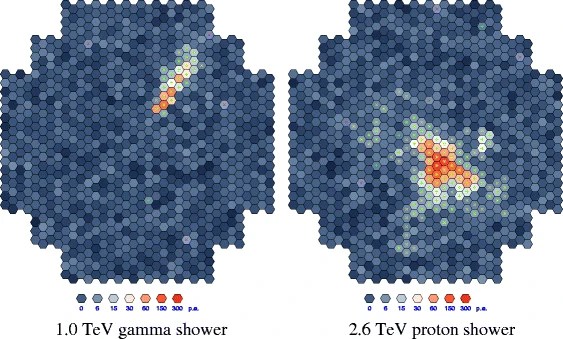
Credit: Völk & Bernlöhr, 2009, Experimental Astronomy 25, 173
A bit of history
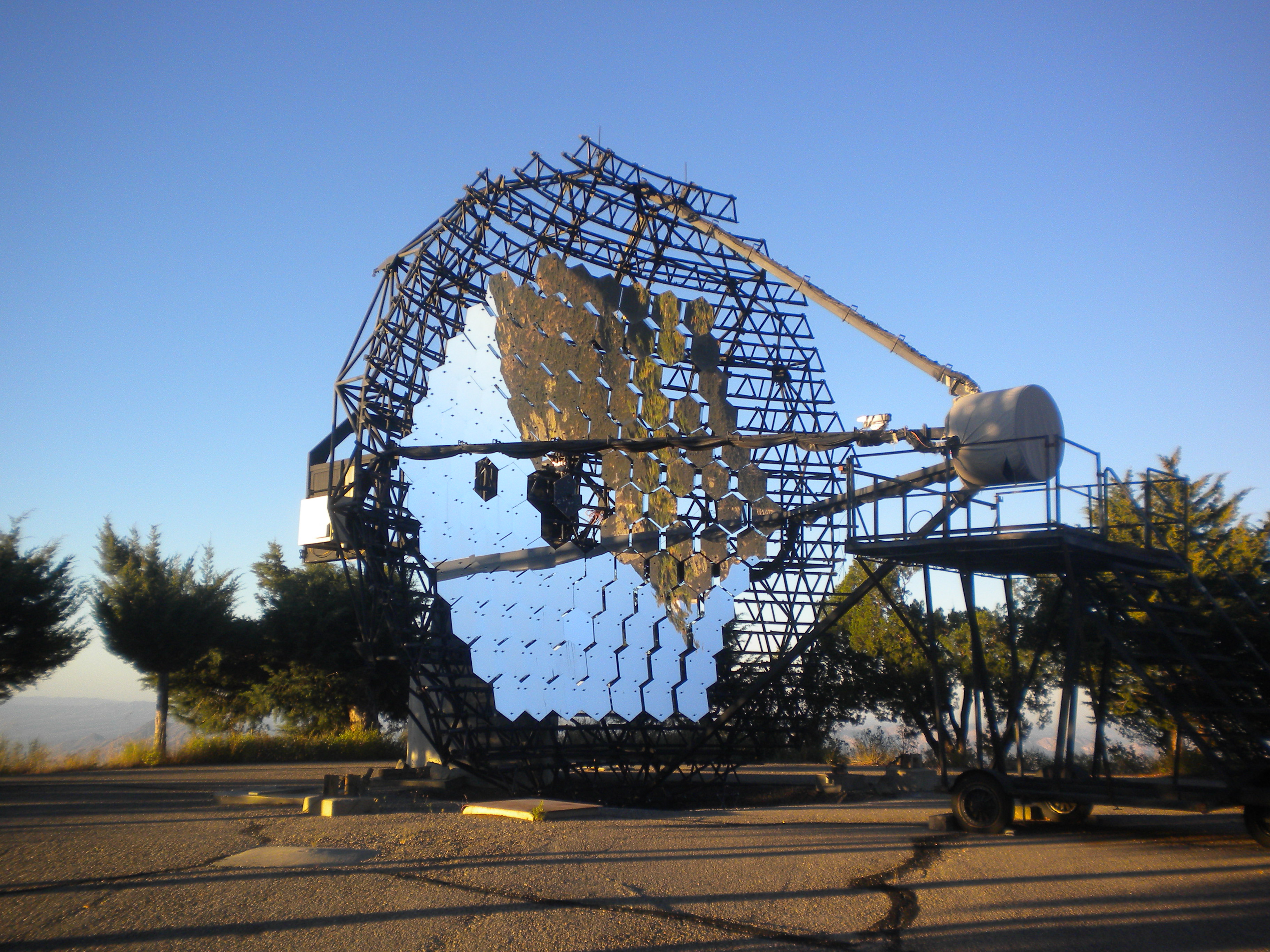
Cherenkov telescopes work the best for photons with TeV energies. The first TeV source seen with Cherenkov telescopes has been the Crab Nebula, imaged by the Whipple telescope in 1989.
Thirty years later, the current generation of Cherenkov telescopes (H.E.S.S., MAGIC, and VERITAS) has brought the technique to maturity. Nowadays hundreds of TeV sources are known, and TeV astronomy with Cherenkov telescopes is considered one of the many pillars of multi-wavelength astronomy.
Active galactic nuclei at TeV energies
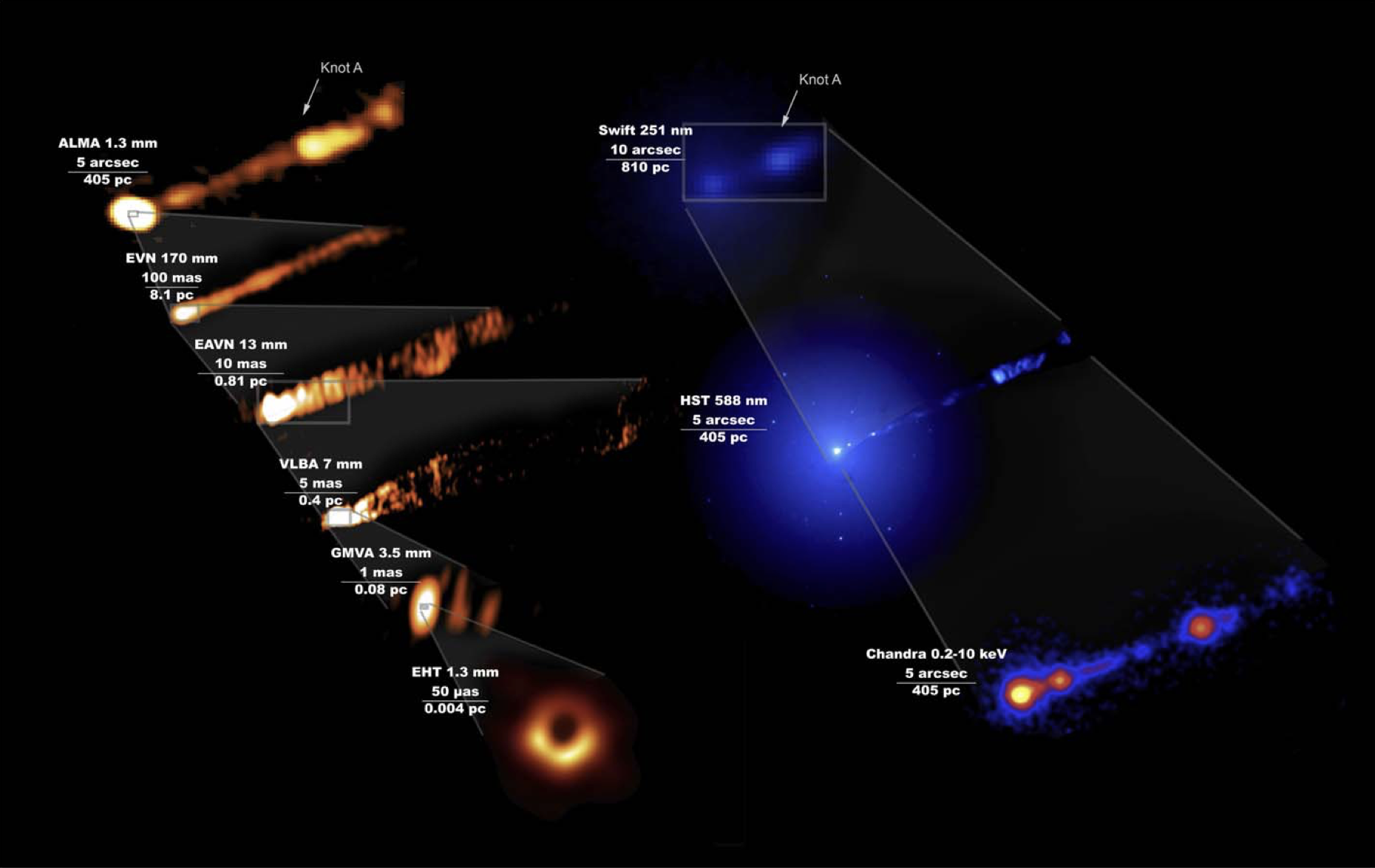
In some active galactic nuclei (AGNs) the accretion onto the super-massive black hole is associated with the ejection of a relativistic jet of plasma along the polar axis. When the jet points towards the observer, relativistic effects boost the emission and make this class of AGNs particularly bright in gamma-rays. We call these sources blazars.
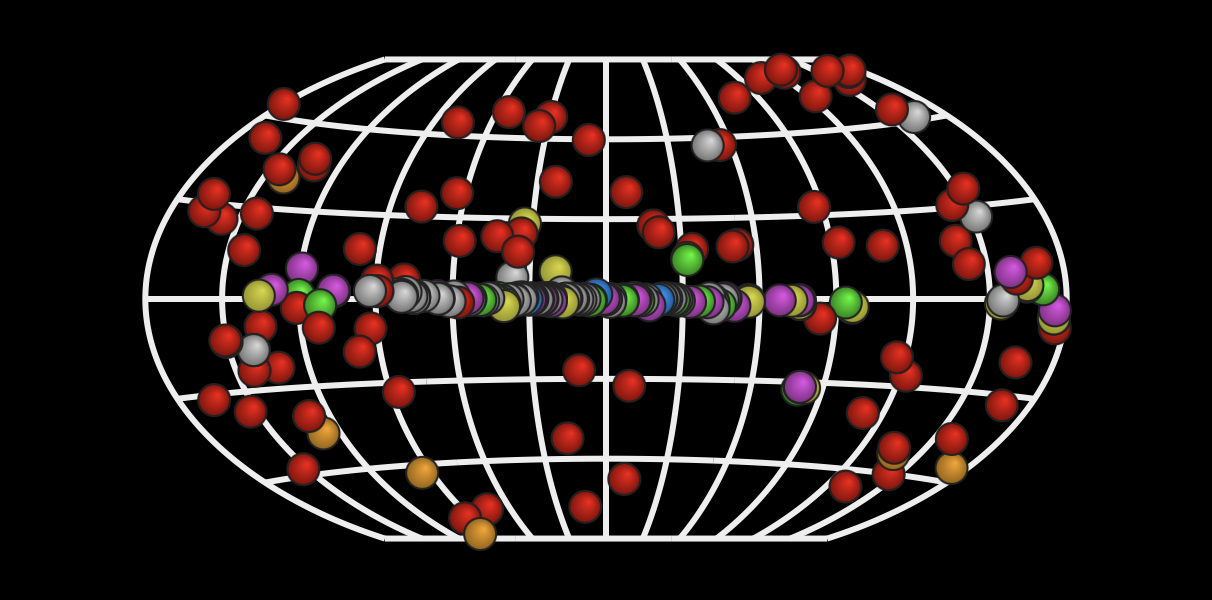
Blazars represent the overwhelming majority of TeV extragalactic sources and 77 of them are known.
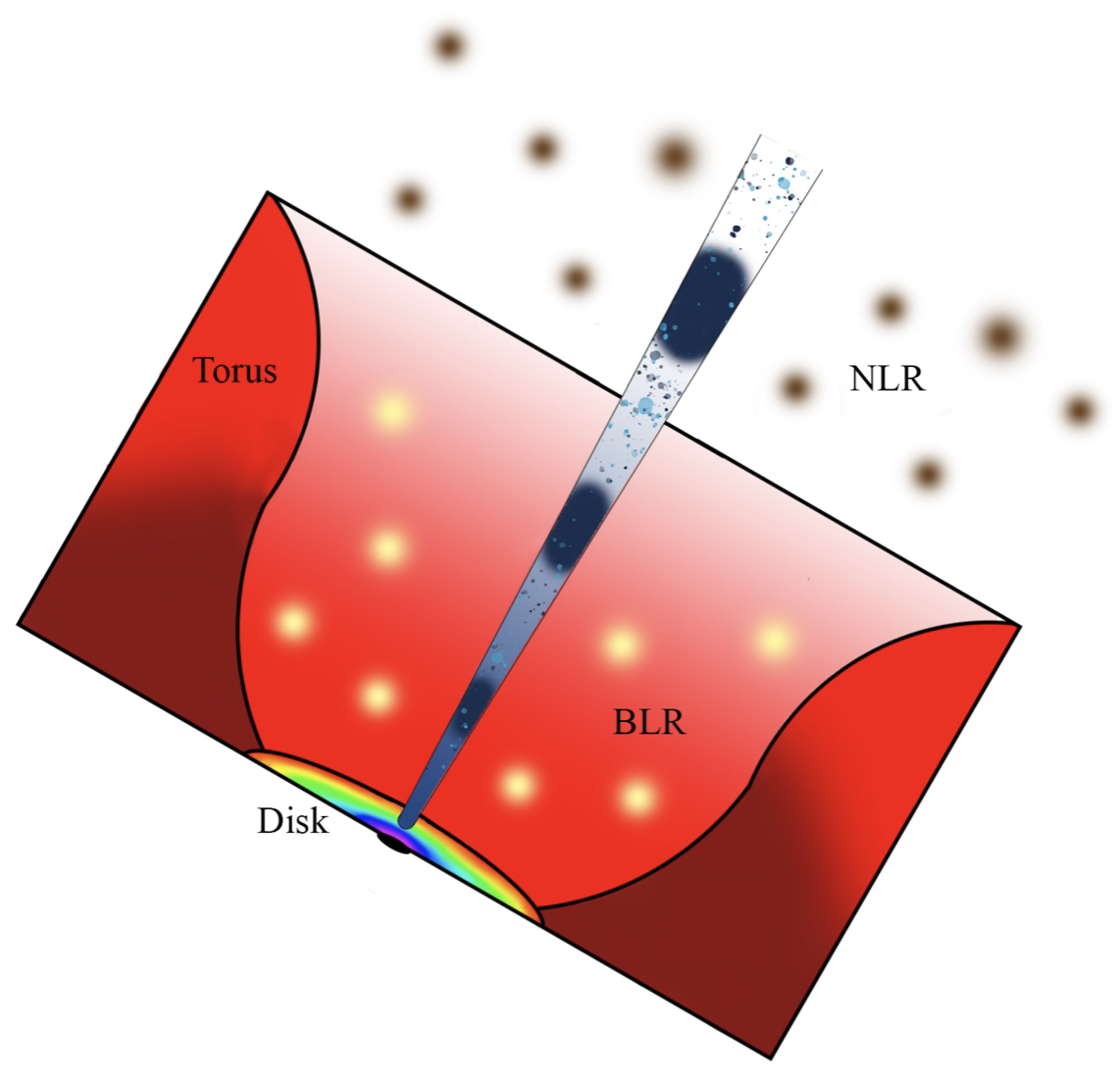

Credit: Cerruti et al. 2017
Blazar classes
Blazars are observed to emit photons across the whole electromagnetic spectrum, from radio to gamma rays. Rapid variability is also a key observational feature.
According to their optical spectrum, blazars are classified into BL Lacertæ objects and Flat-Spectrum Radio-Quasars. According to the frequency at which their emission peaks, they are classified into low (in infrared), intermediate (in optical), and high (in UV and X-rays) frequency peaked sources.
In the TeV band, the large majority of sources are high-frequency peaked BL Lacertæ objects. Flares on minute time-scales have also been observed.
I have worked with all Cherenkov telescopes (H.E.S.S., MAGIC, and VERITAS), studying TeV emission from AGNs. For further details, see the following publications I lead:
- Study of high-frequency peaked BL Lacertæ objects in the TeV band
 Acharyya, A. et al., “Multiwavelength Observations of the Blazar PKS 0735+178 in Spatial and Temporal Coincidence with an Astrophysical Neutrino Candidate IceCube-211208A“, ApJ, 2023, 954, 70
- Abe, H. et al., “Multimessenger Characterization of Markarian 501 during Historically Low X-Ray and γ-Ray Activity“, ApJS, 2023, 266,37
- Acciari et al., “Investigating the Blazar TXS 0506+056 through Sharp Multiwavelength Eyes During 2017-2019“, ApJ, 2022, 927, 197
- Abdalla H. et al., “Very high energy γ-ray emission from two blazars of unknown redshift and upper limits on their distance“, MNRAS, 2020, 494, 5590
- Abdalla H. et al., “Simultaneous observations of the blazar PKS 2155-304 from ultra-violet to TeV energies“, A&A, 2020, 639, 42
- Abdalla, H. et al., “VHE γ-ray discovery and multiwavelength study of the blazar 1ES 2322-409“, MNRAS, 2019, 482, 3011
- Archambault, S., et al., “Upper Limits from Five Years of Blazar Observations with the VERITAS Cherenkov Telescopes“, AJ, 2016, 151, 142
- Archambault, S., et al., “VERITAS Detection of γ-Ray Flaring Activity From the BL Lac Object 1ES 1727+502 During Bright Moonlight Observations“, ApJ, 2015, 808, 110
- H.E.S.S. Collaboration et al., “Discovery of VHE γ-ray emission and multi-wavelength observations of the BL Lacertae object 1RXS J101015.9-311909“, A&A, 2012, 542, 94
- Study of extremely-high frequency peaked BL Lacertæ objects
- MAGIC Collaboration et al., “Testing emission models on the extreme blazar 2WHSP J073326.7+515354 detected at very high energies with the MAGIC telescopes“, MNRAS, 2020, 490, 2284
- Aliu, E., et al., “A Three-year Multi-wavelength Study of the Very-high-energy γ-Ray Blazar 1ES 0229+200“, ApJ, 2014, 782, 12
- Study of Flat-Spectrum Radio Quasars at TeV energies
- H.E.S.S. Collaboration et al., “H.E.S.S. detection of very high-energy γ-ray emission from the quasar PKS 0736+017“, A&A, 2020, 633, 162
- Abeysekara, A., et al., “Gamma-Rays from the Quasar PKS 1441+25: Story of an Escape“, ApJL, 2015, 815, L22
 Matteo Cerruti